Regain Your Confidence In the Saddle

Overcoming fear is something almost every equestrian face from time to time. Mules are large, potentially unpredictable and dangerous animals. But some riders, for a variety of reasons, struggle with fear and anxiety more than others. Few sports have as many dedicated participants who struggle with being afraid of their beloved, chosen equine partner. Fearful riders come in every age, gender, size and ability level. They include riders from every equestrian discipline and level of training. 
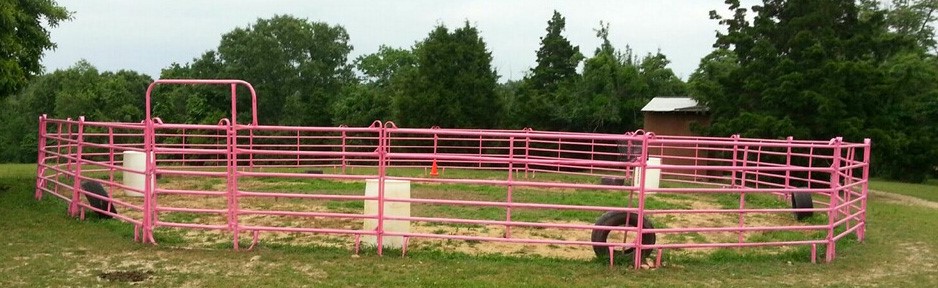
A round pen makes a great classroom for your mule.

I will put emphasis on the fact that equestrian sports are the number one rated in head injuries and death. Directly put, it is a dangerous sport and activity. To think that you will never encounter an injury during your riding career is not probable. Keep your risks to a minimum and think while your train to lower your chances of becoming injured. With that being said, you should realize the inherited risks involved with equestrian sports and take an active role in keeping fit while increasing your knowledge of the sport to minimize your risk.

Equestrian fears usually originate from two distinct sources: post-traumatic fear and generalized anxiety. Post-traumatic fear develops after experiencing or witnessing a traumatic incident or accident. Not every rider who is involved in or witnesses an equestrian accident will develop post-traumatic fear. Some riders seem to “bounce back” from devastating accidents with few long-term effects. More fearful, riders will struggle with crippling fears after a seemingly minor incident. I was raised in a family when after the fall, you got back on. Having that mindset, I developed horse and mule savvy skills that has brought a great amount of rewards to my life. If you are addicted to mules like I am, you will not be able to give it up.
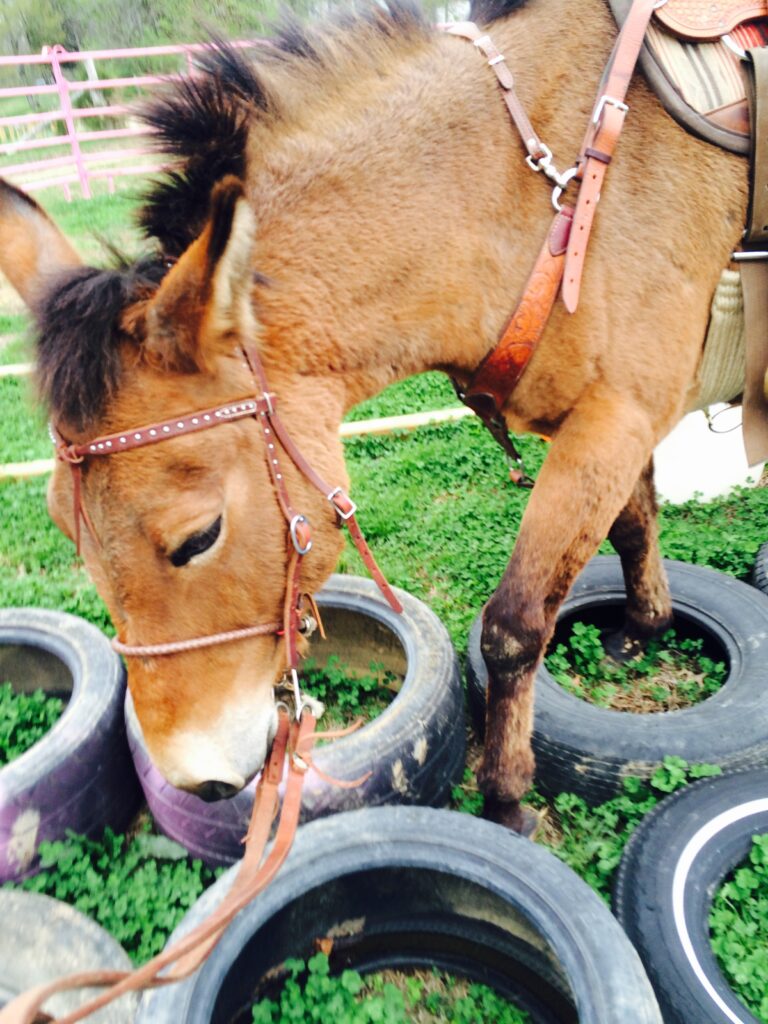
Work with your mule through “thinking” exercises such as walking through tires.

How do we explain riders that have fears even though they have not been injured? Generalized anxiety develops in the “what if” section of the brain. No actual incident has occurred, but the fear is always of what might occur. What if my mule bolts and I cannot stop him? What if my mule spooks at a cow? What if a barking dog chases us on the trail? What if my mule bucks me off? The “what if” possibilities are endless and can be paralyzing.

Older adults have an increased awareness of their own mortality, and often must deal with stiffer, less flexible joints; bones that break more easily; increased body weight; decreased muscular strength; slower reflexes; a lower general level of fitness; and old or prior injuries. These physical realities may increase an already anxious rider’s fear level.

So, what is an anxious or fearful rider to do? First, be patient with yourself, learn to recognize and reward your progress. The steps to successfully overcoming fear are usually small and may feel painfully slow. There are no easy or simple answers to overcoming fear. But there is hope and success for those who are determined to conquer their fears.

 It will be beneficial to enlist your Equestrian Support Team. Fearful and anxious riders will rarely overcome their fears alone. The more support a fearful rider gathers, the more likely he/she is to successfully overcome his/her fears. Possible members of an Equestrian Support Team include: a supportive riding instructor or trainer; a sports psychologist or psychotherapist; a physician or other medical professional; experienced, confident mule friends and riding partners; a supportive spouse, partner or good friend; and friendly mule riding clubs and organizations. Some well-meaning riding instructors add to the problem by refusing to allow their students to talk about their fears. This is not the style of riding instructor I would recommend for a fearful rider, who needs to be able to talk about and verbally process his/her fears. A little empathy and understanding can go a long, long way.

Fear can create these responses: dry mouth, sweating, “butterflies” in the stomach, nausea, “rubbery” legs, shaking or trembling, chest pressure or pain, eyes looking down or losing focus, shortness of breath, “racing” thoughts, inability to focus or concentrate, and the fear of losing control. Now let’s work on this.

Timid, novice and fearful riders should always wear a helmet. Every time, every ride. You never “forget” the girth, do you? Then there is no excuse for “forgetting” a helmet. No matter which equestrian discipline or activity you are participating in, a properly fitted, ASTM/SEI-approved equestrian helmet is the single most important piece of personal safety equipment available today. A helmet may save your life and your future in the event of a fall or serious accident. Knowing your wonderful, unique brain is well protected will give you one less thing to worry about when you ride.

Learn visualization and imaging techniques. Invest in CDs and DVDs that have information about mental imagery and visualization for equestrians. Listen to them when you drive to work or the barn to help you develop imaging skills that will minimize your fears. Visualization and imaging skills require time, practice and disciplined thinking, in order to be effective.

Improve your riding skills. Most fearful riders benefit tremendously from taking additional riding lessons on the basics of riding an older well trained mule. These lessons should be with a patient, caring instructor who enjoys working with timid adults. Lessons on the basic mechanics of riding and controlling a mule, balance, and understanding a mule’s movement will help a fearful rider to relax and feel more in control in the saddle. Ideally, these lessons should take place on a calm “schoolmaster” type mule.

Improve your fitness level. Start with abdominal strength. The abdominal and oblique muscles control your position in the saddle and help you to stay with your mule when he turns quickly. Strong abs make you a stronger rider. Increasing your over-all fitness, strength and flexibility will usually increase a rider’s self-confidence in the saddle.

Look and act like a confident rider, even if you do not feel like one. It is easier to act your way into a new way of feeling than to feel your way into a new way of acting. The physical positions of keeping your eyes up, chin up, and smiling send signals to your brain that you are in control and confident, even if you do not feel that way emotionally. Look and act like you are confident and eventually you will feel that way.

Evaluate the mule you own or usually ride. Are you a good match for each other? Many fearful riders are riding mules they should not be riding. They are over-mounted and intuitively know that, but do not know how to change the situation. If you are not sure whether you and your mule are a good match, enlist the aid of a knowledgeable equine professional to help you. A professional opinion may give you the courage to overcome your fears and work successfully with your current mount or the courage to say good-bye and find a more suitable mount to help you achieve your equestrian goals and find the fun again.
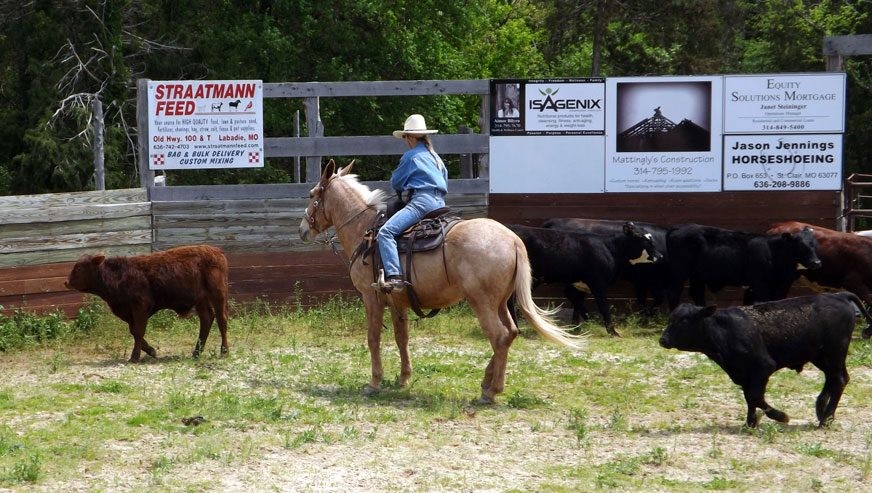
Participating in a riding clinic or equine seminar will boost your confidence.

Make a plan. The most effective plans will usually involve regular riding lessons or instruction, sessions with a sports psychologist or psychotherapist who is experienced with equestrian issues, and mobilizing your entire Equestrian Support Team. Clinics specifically designed to help riders overcome fear issues can be particularly effective in helping fearful riders to get back on the “fun” track again.

In summary, there is hope and help available for anxious riders who want to overcome their fears. Successfully overcoming the fear of riding and becoming a confident rider most often occurs when a strong Equestrian Support Team is enlisted and utilized with a thoughtful, realistic plan is in place. Here’s to your future as a confident rider and a leader in your mule’s life!
Pulls Head Away – Pulls Lead Rope Out of Hands – Evasion Tactic

Cindy,

Thank you for all the great information you provided on understanding and handling mules. Your common sense approach is appreciated.

I have a question that I hope you can help me with. I have two mules that ride, drive, and try lots of stuff with. My 9-year-old molly is pretty advanced in her training, but has a big hole in her fundamentals. I know this is related to respect, but I don’t know how to correct it.

She appears very respectful and will do what I ask her to do. On the ground, she will move in any direction, side-pass away and to me, ground tie, etc. But, if I try to lead her off to somewhere she doesn’t want to go, she quickly bends her head away from me and pulls out of my hands! I am not as strong as a man, so I cannot use brute strength to match her size (she’s 16 hands). What can I do to get and keep her respect? This is the one thing that I HAVE to correct.

Thank you very much for any advice you can give me. ~ Joan

Hi Joan,

I have dealt with this very problem several times and it seems they all were mare mules too!  How funny.  The good news is, you don’t have to be as strong as a man to work with your mule.  I mean, look at me! The fact that your mule “surprised” you and was able to take advantage of the moment . . . well she got away with it so she will try it again.  There are a couple of things you can do: 

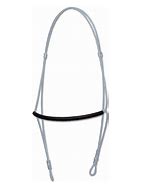
  1. You can use a training cable that will give you a better advantage. The Mustang Cowboy War Bonnet (don’t let the name scare you)  I have used this with getting good results. (shown above.)
  2. You can apply the cowboy halter (self-made from a lariat) that tightens when she pulls away from the handler. Go to this link on how to use it:  http://www.cowboyshowcase.com/cowboy-training-halter.html#.WCh7uIWcGhc
  3. You can work her in the round pen to establish respect and control.
  4. You can also use the Whoa Mule Bridle to establish control.  http://www.everycowgirlsdream.com/bridles.html This seems to be the easiest for handlers to use. 

In my experience, mare mules tend to get anxious or act up when they are in season.  Some mares don’t readily show signs that they are in season but their attitude will change. 

When your mule is “thinking” about pulling away from you – you should get a sixth sense about it and be able to react quickly to establish control.  Flexing her to the right and left daily would also aid in establishing control. 

I hope I have given you some workable solutions – I have applied all the above-mentioned training and they have all worked for me, it just depends on your skill set and what you feel like doing.  Thank you for your email Joan – please let me know how you are doing with this and if you need further help – let me know! ~Cindy K. Roberts

Mule is Forward in the Bridle

Hi Cindy
I was lucky enough to find your website. My new mule is Pricilla, she was a Grand Canyon mule. I’m adding her to my two riding horses a quarter horse and a Mustang. She came last week and I rode for a bit in the round pen. The person I got her from said she figured she had been in a curb bit prior. All I had was a snaffle and she did well 90% of the time except, twice she put her head down and walked fast with zero brakes!

😬

This has made trying her out on the trail a little concerning. I found a curb bit in some old tack, haven’t tried it yet. It seems so severe to what I’m used to. Have you had any experience with x-string mules? Would your hackamore be a better option?

Thank you,

Nancy,

Mules that have had a routine or job for so long tend to lose their confidence in a new situation and look for an out or evasion to their new routine. Also, mules that had jobs and were ready to go to work, put their energy into the task at hand. The Whoa Mule Bridle would be ideal for your mule. My book explains how to fit it, use it, and why things didn’t work out for you in the first place.

I like to talk with people first before selling the bridle, I don’t sell snake oil, and I like to take into consideration the age, background, and demeanor of the mule before I ship the Whoa Mule Bridle. Not every mule is a candidate. If I can answer any more of your questions plz let me know.

~ Cindy K. Roberts

Mule Backing Up – Circling as Evasion Tactic

Dear Cindy,

I’m a first-time mule owner; but did manage to purchase a really nice 10-year-old mare mule, Greta. I bought your bridle a few months ago, not for a running away issue, but for when my mule just stops. (Really because she just wants to stop, not because of any real or perceived danger). When she stops she will start backing up or turning in a circle.  She’s good with her ears, takes her bit well enough, and will go on after a few backs and circles.  But I don’t want to fight with her or cause her to buck or rear. She’s fairly lazy which I like and not easily spooked. She gets to stay out in the pasture with horses and some cows and is easy to catch and bring in. I did have some trouble bringing her in at first, but she’s over that.  So I think it relates to being buddy-sour and accepting me. I can see where the bridle would keep her at a slow pace heading back to the barn, but not exactly how it will make her go forward.  I don’t let her go straight back and I don’t unsaddle her when we get back either.

Thanks for your help, Julia

Julia – thanks for your email. I perceive your mule backing up or turning in circles as a form of “I really don’t want to do this right now” attitude. Interesting. The good news is this is easy to correct. Move your mule whether in a circle or side pass her or work her off her forehand or hindquarters.  The point is, to give her something to think about. Also – whichever exercise  you choose to divert her attention – you should be skilled at setting her up and following through with it. You simply want her to think about this new request – encourage her to follow through and reward her. Then you can move onto something else. If all you r doing is riding her and not offering leadership – your mule would prefer to feel secure and comfortable with her pasture mates. I will be around this eve if you need to call. ~Cindy K Roberts (\_/)

Pretty Mule – Bolting & Bucking

Hi Cindy,

I am hoping you can help me. I have followed your website for about a year and I really like what you do.  I have had mules since 1979 and I have done everything from working them in the woods to plowing, dressage, jumping, driving, and endurance riding. I have attached 2 pictures of two mules I had and jumping and trail riding. I have had horses and mules my whole life and I love mules.

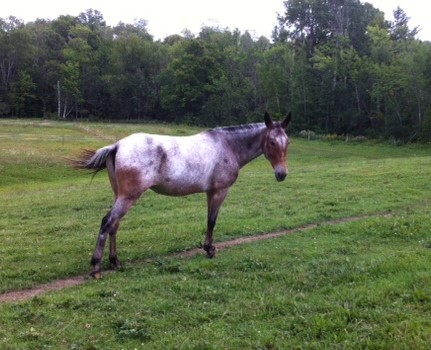
Almost a year ago I got another mule after I lost my 38-year-old mule that I had for 34 years. This new mule is who I need help with. She is an appy mule. Her name is Rose, she is about 6 years old, 16 hands, beautiful looking, really good confirmation, beautiful mover, very athletic, very very sweet, excellent to handle, brush, vet, farrier, trailer, loves attention, she trail rides, jumps, lounges. She sounds perfect and she is almost. I have trained and ridden my whole life and this is the first horse or mule that I have not been able to work through a problem.

The problem is, she has figured out how to get me off of her one way or the other, either by bolting or bucking. I am small, 5ft 5in and about 115 lbs. I am very athletic but I am getting older. (I am 63 years old.) So I can’t keep getting thrown off. I am very sad but I can’t keep her. 

I really like what I see and how you work with animals so I was wondering if you would like her or if you know of someone who would like her. I would give her to you if you paid for the trucking. That problem is that I live in Vermont. I know this sounds crazy but I can’t have her go just anywhere plus I need to be totally up front about the problem I am having.

I have attached 6 pictures of her for you to look at her and 2 pictures of mules I had in the past.

I know this is asking a lot of you but I do hope you will consider it.

Thank you for listening to me and my mule problem.

Please let me know what you think.

Thank you, Name Withheld

WOW. This is the heartbreaking news that troubles me when people buy mules. “She is about x years old.” Records are not adequately kept on mules or livestock. And understandably so. This is where you the buyer should educate yourself on what you are purchasing.

OK, the color thing. If you have the skill set to hang tuff and be able to school your mule to the next level, then I say, get the color of mule that your heart desires. That means, when you arrive at the barn with your new mule, you take the responsibility of giving that mule a job, which gives your mule a life. And we are not talking about a life of leisure either. Pack a sandwich, bring your canteen, and start working with your mule. You, the handler/owner will need to show leadership to that mule. And if you are lacking in this, the mule will quickly pick up on this.

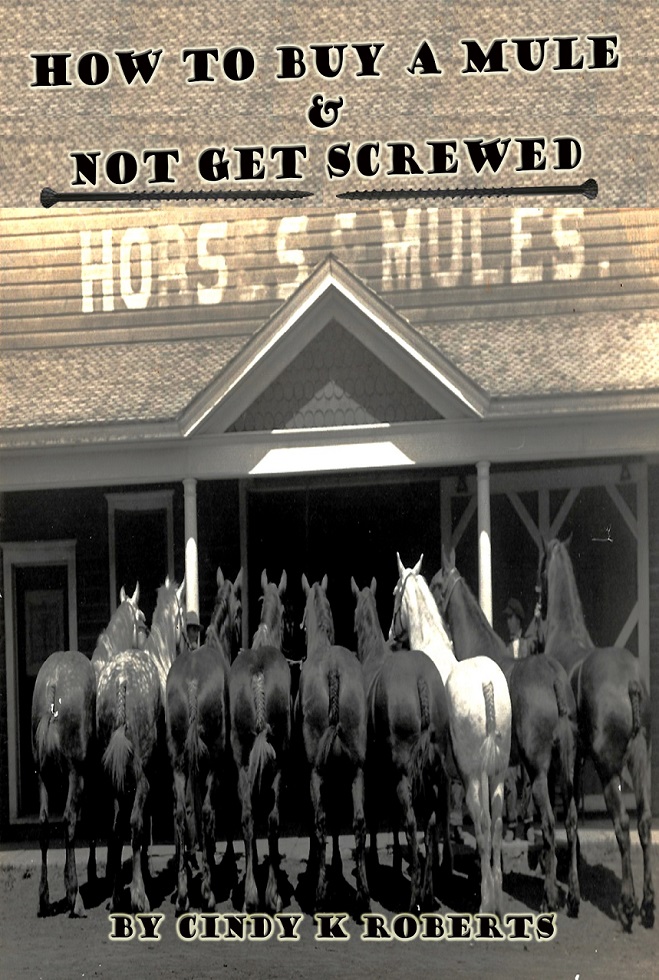
How To Buy a Mule & Not Get Screwed by Cindy K Roberts

Do yourself a favor – educate yourself on buying a mule and what to do after the sale. How To Buy a Mule & Not Get Screwed by Cindy K. Roberts – written by someone that has been in the mule industry since 1985. HOW TO BUY A MULE & NOT GET SCREWED – BY CINDY K ROBERTS (everycowgirlsdream.com)

Won’t Stand Still – Bucks Rider Off

Dear Cindy,

I recently purchased a 10-year-old gelded mule; he rides or he did stand for the farrier and seems to go through groundwork well as I see it. He had a problem keeping his tongue on the wrong side of the snaffle bit or any bit . I purchased one of your whoa mule bridles, and we were doing great with it. Now he started being very ansy and moving off for mounting, by moving backward and sideways. He trys to move forward and I won’t allow that. Got on this am worked in round pen for 30 min. Went to go for a ride and had a tough time getting back on then he bucked me off. I caught him again and got bucked off again, can you help me?

Thanks, Darrel 

Darrel,

Make sure you are not pulling on the saddle when mounting on your mule – this would cause soring him in the shoulder. I don’t know if you are a heavy guy, but if you are, you will want to focus on your balance when mounting. Make sure the saddle fits. And the saddle pad. Any discomfort to your mule and he will certainly let you know about it. I think there is a saddle comfort or balance issue. When habits or behavior issues develop, there is a logical reason for it.  Your mule is uncomfortable; and, it could be the way you ride, or the saddle may not fit, or maybe he doesn’t have near the training you thought he had.  I need to know if the saddle and pad are fitting and if you are in balance with your mule then I can address your issue further. Send me pics if you would like Darrel, I will be glad to help.

Thank you, Cindy   

Jumpy Mule

Hi Cindy, I have a  mule question for you if you have a minute.

I have a young mule, he is around 7 months old. I got him from my father who bought him from a horse sale. What is the best way to get him to calm down and stop being so jumpy? I have never been around mules; my limited experience has been with horses, which was long ago. This mule will not let me touch him, he will smell my hand but that’s all if I reach for his halter, he bolts. If I grab his halter he jumps around like he is crazy and I have to be careful not to let him kick me. once I have him he calms down until I release him. Then we start all over again. I have tried to lock him up in a stall and hang out with him, he gets a little curious but will not let me catch him. What should I do? I don’t want him to get too old and still be like this.

Thanks, Steve

Hi Steve,

Everything you mentioned about your young mule is typical. My book, “Training the Hard to Catch Mule” has a lot of info in dealing with young mules that require halter breaking or additional gentling such as developing that partnership. The book reflects on how the mule perceives events and people in his world. 

For more info click here: MULE TRAINING – THE HARD TO CATCH MULE – BY CINDY K ROBERTS (everycowgirlsdream.com)

Remember, the mule is a whole different animal and your training program needs to be effective and to the point if you want to succeed in working with your mule.  Good luck and keep me posted on your progress – thanks for writing.

~Cindy K. Roberts

Evasion Tactic – Ducking Out

Hey Cindy,

I have had this mule since she was 2 years old, I have broken a shoulder while dismounting but will not blame my mule…funny story. She is 7 now and my best friend for life. Molly has won halter classes and starting on pleasure classes. My question is how to stop these right-hand turns she makes when she feels threatened or is not willing to agree with me. Can you give me advice so I can help her? She does everything else asked of her with no problem.

Thank you, Pam

Hi Pam,

Your mule lacks confidence in certain areas and it could be that you made a pet out of your mule. Making right-hand turns or “ducking out” to avoid completing a request is what the mule will do when they are lacking in confidence. It could be that you are not being clear in your request, and your mule doesn’t understand. It could be that your mule needs more foundation work to be confident and able to perform the task. Always be clear and consistent with your requests.

Working on the lead line properly and focusing on the handler is required since day one when working with mules. This has to be established in order to progress in your schooling with your mule. And, mules look for leadership since they are prey animals. 

Your mule doesn’t respect you as being the leader.  Harsh corrections are not going to solve this issue.  Seven is the age when the mule is mature and should be willing and confident provided he/she had positive and effective schooling. Confidence Training for The Western Saddle Mule will enable you to move forward with your mule’s schooling. 

Work on her foundation training to establish confidence and move forward from that. Keep a positive, working relationship going with your mule and she will look forward to learning and pleasing you. Thanks for writing and let me know how things work out. 

Cindy,

Thank you for your advice . You may be right, we both lack confidence; me being fearful of getting hurt again . My mule gives me all she has when I ask her to, but, when a man gets too close that’s when the right-turn evasion tactic happens, but we will keep working on it .

Thank you again. Pam.

Mule Strikes at Handler

Hi Cindy,

I hope you will give me some encouragement and direction. Today I was leading my molly mule (2 years old) down to some green grass.  She was haltered.

Then the jenny donkey came lumbering down the hill and as I was trying to get out of the way Cinnamon reared up and struck out at me! Or so it seemed.

Maybe she was doing this in response to the donkey, I don’t know. All I know is she got my shoulders—not bad enough to cause serious injury—thankfully. 

I was so flabbergasted I yanked on the halter and just stood in shock; thinking how serious it could have been and wondering what am I to do??? As I caught my breath and my heart stopped pounding (the hit was much too close to my head), I lead her to the grass area; she was throwing her head and acting unruly.

I got them both into the grassy area and left her and the donkey to graze.

The moment is gone now, but is this just ‘one of those’ and forget it? We’ve had her for about 5 months now and I’ve not experienced anything like this before.

She is constantly exerting her dominance over the donkey, so maybe this is the root cause. And I just happened to be in the way…would you give me your thoughts and any suggestions?

Thank you much,

Carolyn

Dear Carolyn,

It is a scary moment when your mule strikes out at you.  It happened to me once many years ago and it was a life lesson that has kept me on my toes ever since.  Your two-year-old is so very young and this is typical behavior coming from a youngster.  I wasn’t there to see it, but I am wondering if the donkey was coming from behind where you and your mule were…and anything approaching from behind (at any angle) appears to the mule to be traveling up to three times faster.  So visually, animals, people, and objects approaching from behind give the appearance that something is coming near.  Mother Nature allows this keen sense to the mule and horse for their protection from predators.  I am not sure if your mule struck out of fear or from being playful.  Young mules exhibit playful (kicking out) behavior in the barnyard or pasture with their playmates. 

However, you are not a pasture buddy so you have to enforce boundaries here.  Do not allow your mule to crowd into your space at any given moment.  When working with young and/or unruly mules, always carry a crop or buggy whip as an aid (to reinforce boundaries) when you need it.  It is spring time and therefore, playful and rowdy behavior can be expected.  Also, your young mule is establishing dominance simply because she can.  Her hormones are raging and your mule is developing physically and mentally.  When your mule is seven years old, you will notice a considerable change in her maturity level and that is when you realize, the time you invested into your young mule was well worth it. 

For more information on my books that offer mule behavior and mule training go to:  http://www.everycowgirlsdream.com/store.html

Thank you for writing Carolyn and keep me posted on your mule’s development.

~Cindy K. Roberts

Cindy,

Thank you so much for your quick and thoughtful response!

I spent a lot of time thinking about the incident and I do believe it was in response to the donkey coming up so quickly, causing wild disruption—for all of us.

And yes, it has made me decide to be more aware and careful around both of them.

Cinnamon and I have a good bond, so I don’t believe it was to hurt me.  If she had wanted to hurt me, she surely could have at that moment.

Today is a new day!

Thanks again for taking the time to encourage me!

Carolyn

New Mule Owner

Dear Cindy,

Although I’ve owned a TW horse for years, I’ve only now become a mule owner too, and have a couple of training questions for you.  My mule is a five-year-old gelding and was used by his previous owner for extensive trail riding.  He is a pleasure to ride, but his ground manners need a lot of refining, and I’m having trouble getting him to do what I ask on the ground.  My two problems:  first, he refuses to stand still / stand by a mounting block for me to get on.  And second, sometimes when I lead him, he either refuses to be led and plants his feet, or tries to push ahead of me. 

The methods I used to teach my young TW mare these things don’t seem to work with my mule.  Can you make any suggestions?

Thanks very much,

Jodie

Dear Jodie,

It is natural for a mule to want to step away from a structure such as a mounting block.  Then to have someone step up on a block, you are now towering over the mule and this makes the mule nervous.  This is what predators do, right?

There are several things you can do…I will suggest one for starters.  If the mule is not too nervous, you can give a handful of oats as a treat to “distract” him just enough while you step up into the saddle.  However, after mounting, you should pet him and encourage him to stand for a minute before walking off.  Too many riders, mount up and take off and the mule never forgets what is going to happen next, so they take off before the rider is ready. 

I have trained nervous mules to stand quietly at the mounting block.  It takes time and patience.  I quietly move the block, place it by the mule’s shoulder, give the mule a handful of oats to reward him, and next, pet him. There’s no reason to rush this along, I mean, where’s the fire anyhow?

The next phase, I step up on the block, reward the mule at the same time for reassurance, pet him, and tell him how good he’s doing. Sing a little song at the same time if you really want to get his attention. I mean, how many handlers sing to their mule? Ha!

After your mule becomes comfortable in accepting the mounting block with you standing on it, (and if your song was cheery) you should be able to mount up quietly on your mule.  After quietly mounting, encourage the mule to relax and stand for a minute.  It’s not rocket science, it’s just merely taking your time to work through this process.   

This and more groundwork information is available in Answers To Your Mule Questions available here.  Thank you for writing and let me know how things progress for you.

~Cindy K. Roberts