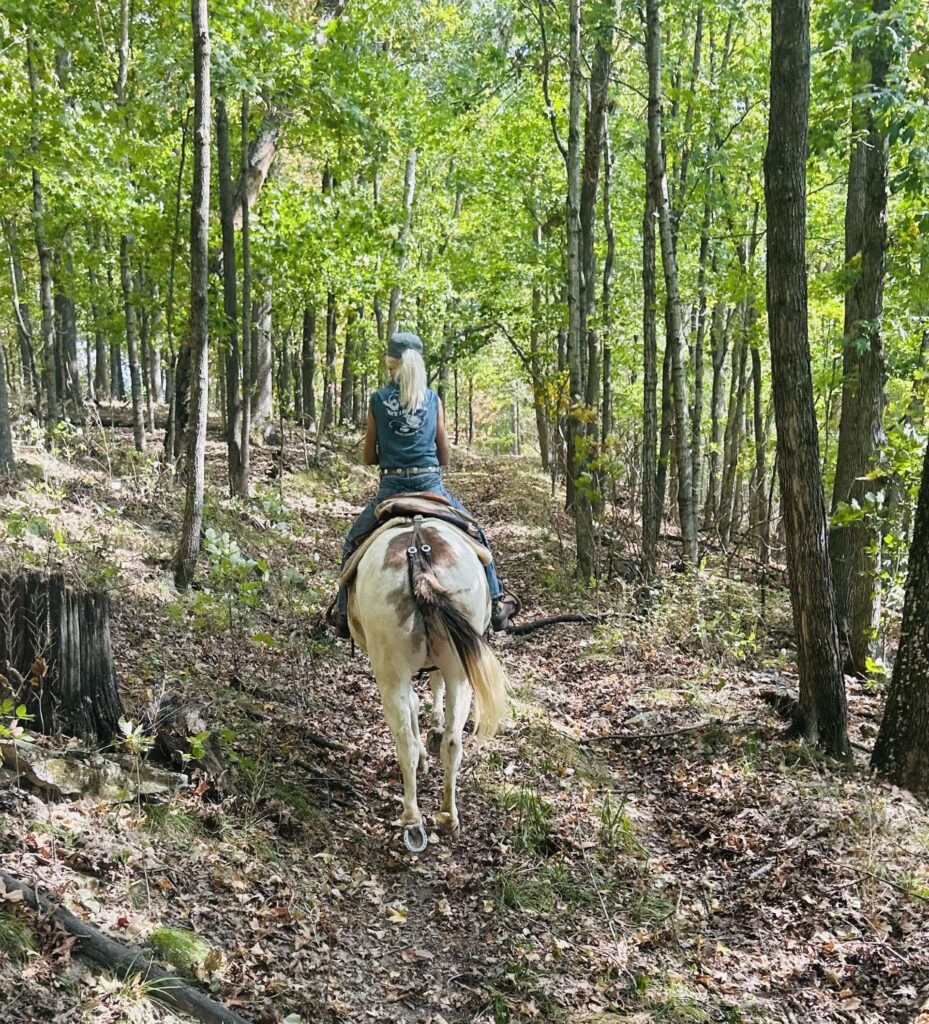
Cindy hope you are well. My mule is still having trust/come-to-me issues. I spend as much time with her as possible. She still will not walk up to me unless I have a treat and then only to be able to get a treat and retreat. She sees how we treat the other horses and pays attention to them. No matter what I do the only way I can catch her is to verbally ” Lunge” her around the corral. At first, it took about 4 laps and then she would stop and turn to me and let me walk up and rub her neck and take her halter. The first time I just rubbed her neck and talked back to her and released her. Then I put the lead rope around my neck so she could see it. She moved off again but then stopped after one lap and let me catch her. I then brushed her, led her around, checked her feet, talked to her, and released her. I have altered my routine every time I catch her, she never knows if I am only going to give her a rub and pat or if I am going to lead her or brush her or ride her. She is riding great but has some bridling issues that I will discuss later. That is the only process that has worked for me. Any suggestions? Enjoyed the book “Answers To Your Mule Questions” and plan on reading it again. You have a talent for writing.
Does your mule hackamore come in different sizes? She has a pretty large head and a regular bridle is tight. She still puts her tongue over the bit so I plan on ordering the hackamore soon.
Blessings,
Name Withheld
Dear Sir,
I have worked with older mules that were very hard to catch. I found it better to place the oats inside a bucket, then place the nose of the halter over the bucket, when the mule dips his/her nose into the bucket, scratch her neck (to desensitize) her at the same time. Quietly and calmly, secure the halter and continue to feed her. It is OK to have this routine established because the previous owner(s) have neglected to work with her with honest intentions. This technique may take several tries to where the mule willingly will dip her head into the bucket and wait for the halter to be secured.
There is another way that I prefer to use on haltering hard-to-catch mules. Having the mule in a corral or paddock, I will keep oats in a small cup tucked inside my jeans, walk up to the mule with the halter on my shoulder. Approach the mule, and for as long as he stands there, tell him what a good mule he is. Shake the cup of oats, to let him know you do have something for him. Offer the oats with your hand, by doing this, nibbling from your hand is a connection the mule makes; offering treats will often develop the bad habit of being able to dine and dash. They grab the “treat” and off they go.
Some mules are so unsettled they will not put their head in a bucket to eat. It just takes time for your new mule to feel secure in his new surroundings, but you will have to work with connecting with your mule, because after all, YOU ARE IN A RELATIONSHIP. So, make it a good one.
With older mules, it can take longer in repetitious handling/gentling techniques before they feel secure in forming a bond with their handler. This is OK; remember, the mule doesn’t forget ill-treatment or deceitful techniques used in their schooling. Feeding a treat, slapping on a halter then going to work is viewed as dishonest coming from the mule’s perspective. There has to be a relationship.
Early in the relationship, by walking out to the corral, rewarding the mule for approaching and walking away is good. Repeat this process. Always reward with a handful of oats, that way your mule can’t do the dine-and-dash maneuver by grabbing what’s in your hand and running away with it.
I have tossed oats on the ground to encourage a mule to approach me. It takes more time with older mules to decide that you are OK, but with a positive and honest approach to their training, they do look for you to be their friend.
Keep in touch — I want to know how this works out for you.
Due to the hypersensitivity of the mule, their mental state can easily escalate into an anxiety level that would encourage bad behavior. You see, mules can feel energy from other equines and from a person. Their intuition is far keener than ours and mules will often mirror the feelings of their rider and respond accordingly. Our world is different from the mule, as humans we view emotions differently than mules do. We may mask our feelings. But in the presence of a mule, these animals can sense the way we really are. When a person interacts with a mule, they become part of the mule’s environment, and that person ultimately becomes a herd member.
One reason some people prefer mules to horses is that the former are generally easier keepers. A mule approximately the same size as a horse, at a similar level of work, consumes less feed. A mule can eat anything a horse eats, but he uses it more efficiently. For the sake of not overfeeding your mule, consult your veterinarian for the best diet for your mule or donkey.
Always remember, you can never force a mule to obey you. If you forget this rule, your mule will remind you when the appropriate time comes. If you try to force the mule, any compliance will be short-lived. The best methods are based on explaining to the mule what you want. If you use a method of restraint, like a twitch or a Scotch hobble, it must be approached with the idea that you are explaining to the mule that you want him to stand still, not that you are forcing him to submit. This is where a good degree of handlers often fail in their mule training.
Handlers often try to “drive” a mule to compel it to do what they wish. Horses may be driven or pushed into an impulsive state of energy. When a whip is applied to the horse, he will instinctively spring into motion (although sometimes not in the desired direction). When a whip is applied to a donkey, his instinct is to remain where he is until he is sure of the situation. If an abusive handler were to continue to whip the donkey, he would become more resolute and may drop to the ground in a heap of defiance.
It is not the donkey’s nature to panic and flee, as may be observed when a donkey is spooked. He will walk or trot (or, in an extremely frightening situation, canter) a short distance, stop, and evaluate conditions before going farther. A spooked horse may bolt uncontrollably over a great distance, causing harm to himself and/or the rider in the process. What puzzles many mule handlers is that in any given situation the mule may act like either the donkey or the horse. The muleteer must recognize and appeal to both the horse and the donkey temperament resident within the mule. Most of all successful mule trainers recognize that the mule is a unique individual.
A mule’s or donkey’s attitude to his work is one of partnership with his handler. While well-trained horses obey without question, mules and donkeys are more task-oriented. They seem to be concerned with the overall job, rather than with isolated cues. Once you have taught a job to a mule, he will continue to perform the task almost unaided and in clockwork fashion. If you interfere with his task by continually giving cues, he will be offended and may resist.
Mules are renowned worldwide for their outstanding muscular endurance, but what gives them this ability to outshine their horse and donkey parents? Hybrid vigor has long been recognized and widely exploited in animal and plant breeding programs to enhance the productive traits of hybrid progeny from two breeds or species. However, its underlying genetic mechanisms remain enigmatic.
Researchers from Northwest A&F University in Yangling, China, set out to understand more about the molecular mechanisms at work in mules that provide this superior muscular endurance.
They said their work, in which muscle, brain, and skin samples from mules, hinnies, and their parents were tested, revealed significant differences between mules and hinnies, as well as differences between mules and both of their parents.
Apart from skeletal muscle tissue, which is the main difference that separates mules from hinnies and their parents, there are also clear differences between these animals in both the brain and skin. The findings, they say, provide new insights into the genetic mechanism underlying hybrid vigor in mules. The work could provide the basis for future studies of the genetic and molecular mechanism of hybrid vigor in donkeys and horses.
Interestingly, the mule has a different odor altogether. He doesn’t smell like a horse and he doesn’t smell like a donkey. This could very well be a factor in sensitive horses decide not to accept a mule as a herd member, simply because of his physiological traits provided by Mother Nature.
As prey animals, horses prefer to stay in herds, and communication is accomplished by body language rather than vocalization and sound. They rely on body position and subtle body and head cues, even the twitch of an ear or the widening of an eye, to communicate within the herd.
Overall, mules tend to be healthier, sounder, and live longer than horses. This might result from hybrid vigor, and the genetic superiority of crossbred animals. Mules are less prone to injuries because again, it is due to their heightened sense of self-preservation.
So why are mules known for being kickers? If you think about it, the horse is the nervous nellie in the mule equation. It is the horse that is prone to kicking and horses are nervous creatures. The horse mare handed down the kicking trait to her offspring the mule. The mule being naturally suspicious and cautious should be worked with or trained not to kick. This is simple enough by tying the mule in a rope halter to a tree or hitching post; using a lunge whip or broomstick merely to touch his legs up and down while assuring him this is ok. If the mule has been owned by a heavy handler, he may be fearful of the whip/broomstick; simply caressing his sides and topline while rewarding him will help him through this process. After several days of introducing the touching of the legs with a lunge whip or long stick (along with moving your hands in closer to the mule’s leg), the handler will be able to ask the mule for his foot. By doing this, a soft cotton rope placed around the ankle and then pulling up while asking for the foot is foolproof. Holding the foot for a second or two is best in the beginning.
When working with young mules (6 and under) keep in mind their mental state is different than compared to a horse. For one, the horse will go along with you and submit to you, whereas the mule will carefully think things through first. Handlers tend to rush a mule’s schooling, not realizing the damage that can be done by doing so. Anytime a mule is lacking an introduction to a new task or lacks foundation training will undoubtedly show up in a mule’s confidence level; and at some time, somewhere it will surface. That is why the working partnership you have with your mule is critical to your training program.
A recent interview with Brock Milam of Milam Mules (Missouri) gave sound advice about working with mules. He said, “To be successful and to really get along with that mule, you have got to take the time and learn that mule. And let that mule learn you. If you let him get by with things, then it is a matter of time before an unskilled rider will decide to trade off for a different mule.”
I think we tend to have so much going on at work and at home that we spend time with our horses and mules as recreation/therapy time for us. We release our nervous energy at the barn, check our cell phones for updates and we tend to lose the connection. Remember when you are with your equine partner, he has a heart and soul…an emotional side to him that is looking for leadership and comfort. Stay safe, ride your ponies, and don’t forget the oats.
Working with mules over the years has kept me amused, captivated, fascinated, and focused, as well as being challenged. I like a challenge; it develops your creative side to problem-solving. And what better way to develop your skill set in problem-solving than by working with mules?
And now…I am creative, and I have problem-solving skills. Mules have also helped me to develop my independent side. I remember some years ago, hauling back from Colorado from a mule event, I had a palomino horse mule in the trailer; my trailer tire blew on the highway and I could not get cell service. So, I pulled the roadmap out, placed my pistol in my vest, saddled up my mule, and rode into the nearest town. A couple of hours later, I was back on my way.
Another time, the axle broke on that very same trailer while hauling through Kansas. I saddled up my mule and rode back through town to a horse motel that was a few miles down the road. The trailer was still under warranty, I was laid up for a couple of days at the horse motel. When I got home, I sold that trailer.
I suppose if I had not established myself as a leader in my mule’s life, we would have never made it out of the trailer during these emergency road incidents. You see, mules are sensitive creatures and will easily feed off your emotions. That is why your durability as a trainer is significant in working with mules. Leadership, herd boss, whatever you want to call it, the mule knows if you have grit or not. Being prepared and having confidence will help to develop your leadership skills; just remember a mule does not want to hang out with sissies. A sissy will just drag down the herd; mules know that to be safe from predators, the herd must be strong, healthy, and have it together.
A keen sense of awareness is what Mother Nature gave to the mule. In other words, mules have a high sense of self-preservation, so it is in your best interest to have it together when you approach your mule. That very mule already sized you up the very moment you walked into the corral. That mule already knows what your demeanor is for that moment; that is why you need to be established as a confident leader. I guess in a lot of ways…you are working with a smart ass.
Look, nobody likes a smart ass. They can make you look stupid. They will do things to get your attention when they are bored…because that is what mules and smartasses do. Mules will chase anything in the pasture and run from lawn equipment that they have been exposed to for years…all to work off excess energy.
You probably already know this, but mules can open doors, crawl through, or jump fences to visit in the next pasture, then return home just in time for you to feed him. And to think, this all started from boredom.
Now that you are aware that your mule is bored, you now decide to vamp up his training program. You take the time to set up an obstacle course around the barn to train your mule…except for one thing. Your mule responds by testing you…after all that is what they do. (wink) Mules will question you about the need to walk through a tire obstacle when they can easily walk around it or jump over the stuff in the first place. I mean, what’s the point?!
Again, they will question you…why get into the trailer when the other horses and mules are just tied up or hanging around? When crossing a bridge or river…is it really necessary to cross here? After all who is in charge here? This is the mindset of the mule…remember, it is his job to question you.
This is where the leadership thing comes in. It is your job to be the leader; you are the one in charge, your decision to ask the mule to do something should be based on that the mule is mentally and physically prepared to accomplish the task. It is essential that no harm will come to your mule, and you as the leader give him time to think about it to check things out. Successful mule trainers set up a situation where their mule will succeed. You want your mule to believe in you and to quietly show you that he is trying. By giving the slightest try, you the leader will give praise and encouragement to the mule. Your approach when presenting new things to your mule is important. The mule needs to be comfortable to be willing and to be able to respond to your request because they are emotional creatures. And remember, mules are supposed to think things through and check things out first because they are smarter than both their parents! The mule is simply behaving as the awesome creature that Mother Nature allowed him to develop into. After all, he is not supposed to be a horse or a donkey. He/she is just being a mule, the very smart ass that you are working with!
It is the mule’s job to think of clever ways to get out of what you want them to do. It is your job to be creative in your training program to get the mule’s curiosity stirred up while ensuring no harm will come to him. If the mule suffers injury then the deal is off. If things get boring, then your mule has no further interest in the lesson.
Now that you know you are working with a smart ass; you have your work cut out for you. You are not a whiner; you are determined to succeed. You possess the qualities of being a successful mule trainer. You are committed, conscientious, sensitive to your animals, creative, playful, logical, independent, and patient. You look for answers and you know what it takes. You realize what the mule needs physically or mentally and can follow through in giving it. OK! NOW WE’RE GETTING SOMEWHERE!
All right, you’ve got this…carry on. If you need help, you know where to find me.
Publisher/Author, Cindy K. Roberts has a lifetime experience with training horses and mules; riding the family pony at age 2 was the beginning. Her grandfather, Lieutenant Wilton Willmann a sharpshooter and muleskinner of the U.S. Army Cavalry (stationed in Fort Riley, Camp Perry, Fort Leavenworth circa 1924) gifted her with the insight on mules; and the desire to study and work with them. Shooting firearms and working with horses and mules was desired and expected in the family.
Cindy is host of Mule Talk! The podcast about mules. She enjoys the western way of life, educating new mule owners in working with their own mules, hosting mule events, and documenting her own adventures in keeping the cowgirl spirit alive.