On the trail, I meet a lot of riders who tell me they want to buy a mule for trail riding, hunting, packing, etc. Here are some of the things I find myself saying to them on a regular basis.
1. Mules will always keep you humble.
If you have a big ego and you end up buying a mule, your ego will be knocked down a few notches. Does your mule load into every trailer, no matter what, and do you like to boast about it? Do it in front of someone you just met and watch in disbelief as your mule suddenly forgets how to load. They will take every opportunity to make a fool out of you, so you better have a good sense of humor since you will be the brunt of all their jokes.
2. Mules will always keep you safe… if you can stay on their back, that is.
A lot of people have the misconception that a mule being their 1200-pound babysitter will keep them from all harm. The thing is, mules are very smart and have a great self-preservation instinct. They DO NOT in any circumstance want to get themselves hurt or to put themselves in a situation where they could die. They will keep themselves safe, whether you’re on their back or not. That includes jumping 30 feet sideways at a potential mule-eating bush or bolting away at a dead run from an angry water bottle/bicyclist/plastic bag/dog/whatever else could kill them. If you have a really good seat, you may not get hurt, but if you’re a rider getting back into the sport because you’ve been hurt/lost your confidence/lost your stirrups and confidence at the same time, you might be unpleasantly surprised.
A horse will jump off a cliff for you, but a mule will watch as you go plummeting off the edge while he’s sitting high and dry.
3. If you end up getting a mule so you have a pack animal that you can use for hunting, you might be disappointed when that said mule is petrified of the smell of blood.
Some mules will pack anything, some mules will lose their minds when they smell blood. Yes, most of them can be trained eventually to get over this but for the guy/girl that only rides twice a year: one to leg their horse up for hunting season and two for the actual hunt, you might be very frustrated and let down and you might even lose your cool so much that you will have the urge to hunt your mule instead of that deer.
4. Mules are not stubborn.
They are extremely smart and will a lot of times outsmart their owner. If you own a mule you will constantly have to be one step ahead of them and constantly be in a state of trying to outsmart them. It’s like conquering a video game, mastering an instrument, or something of the sort to me. Once you figure one out, each one will be easier and easier.
They keep me thinking and always impress me when they outsmart me.
5. Once you figure out your mule and your mule figures out you, you will realize why so many people have mules.
They become extremely loyal and trustworthy and their personalities are so enjoyable. Their surefootedness and brains under saddle will ease you even in the trickiest of trails. They will keep you laughing and bring a smile to your face even if you’re having a terrible day.
This is a post that has been shared on social media by Cross Country Equine.
The mule being a different animal, should be recognized as individuals and trained accordingly; those 63 chromosomes produce a unique and hardy animal that has an emotional side to him as well as a calculating mind that enables him to think things through when approached with a new task from his handler. If you take into consideration the physiological components in a mule, and understand their meaning and what they provide, then working with your mule will now be rewarding and far more productive. The physiological components of the mule are listed below.
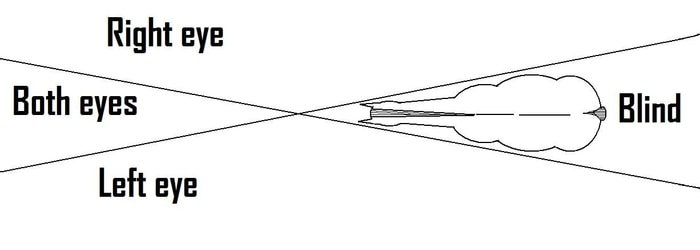
Vision – The mule’s eyes are among the largest of any land mammal and are positioned on the sides of the head. The range of vision is 350°, with approximately 65° of this being binocular vision and the remaining 285°is monocular vision. This enables him to spot predators or potential predators. The mule’s wide range of monocular vision has two “blind spots,” or areas where the animal cannot see: in front of the face, making a cone that comes to a point at about 3–4 ft in front of the mule, and right behind its head, which extends over the back and behind the tail when standing with the head facing straight forward.
The placement of the mule’s eyes decreases the possible range of binocular vision to around 65° on a horizontal plane, occurring in a triangular shape primarily in front of the mule’s face. Therefore, the mule has a smaller field of depth perception than a human. The mule uses its binocular vision by looking straight at an object, raising its head when it looks at a distant predator or focuses on an obstacle to leap over. To use binocular vision on a closer object near the ground, such as a snake or threat to its feet, the mule drops its nose and looks downward with its neck somewhat arched.
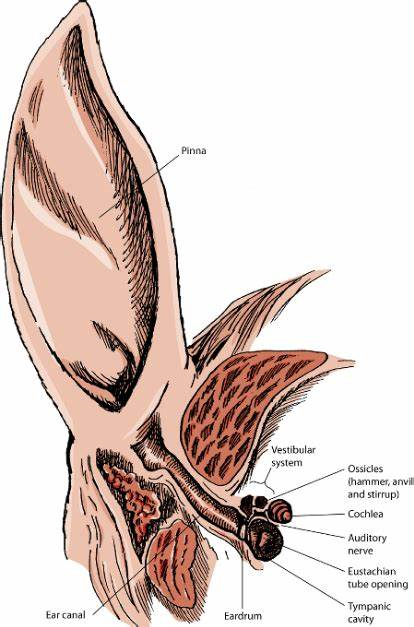
Hearing – Mules hear sounds over a wider range of frequencies than we do, although the decibel levels they respond to are about the same. Humans with good hearing perceive sound in the frequency range of 20 Hertz to as high as 20,000 Hertz, while the range of frequencies for mules is reported as 55 to 33,500 Hertz with their best sensitivity between 1,000 and 16,000 Hertz. The mule’s ears are shaped to locate, funnel, and amplify sounds. Mules have the ability to rotate each ear independently as much as 180 degrees to pay attention to a sound without turning the head. The ears are also used to express and communicate.
Smell – The mule has an acute sense of smell that they regularly employ to provide them with information on what is going on around them. Mules use their sense of smell in many different and important ways. Mother Nature equipped the mule with a strong olfactory sense that can tell the animal whether a predator is near. All it takes is a strong upwind breeze to bring a dangerous scent to the attention of a wild herd of donkeys, mules, and horses. After getting a whiff of the predator, the herd literally high-tails it (their tails stick way up in the air as they flee) out of there in a flash. Although domestic equines are kept in an environment where they are protected from predators, the instinctive behavior of being highly aware of their surroundings is self-inflicted. The mule has developed a high sense of self-preservation and will not approach danger.
Skin – The skin of a mule is less sensitive than that of a horse and more resistant to sun and rain. This makes mules a dependable option for owners who work outside in harsh weather and strong sunlight. Mules are slightly less sensitive to the elements because Mother Nature intended them to be hardy. But remember a mule uses their skin, lips, hair, nose, and their muzzle to their physiological advantage. Their sense of touch is their most acute sense. The mule can sense a fly anywhere it lands on them, and twitch that specific muscle to get the fly off.
The skin also provides a protective barrier, regulating temperature, and provides a sense of touch. Mules from draft horse mares and mammoth jackstock breeding will have a different thickness of skin; their skin will be thicker. Mules from Thoroughbred mares tend to have skin sensitivity issues due to their skin being thinner.
How sensitive a mule is, depends on the age, the training, and the breeding. A mule that is overly sensitive to touch will usually stay that way during his lifetime; it is simply physiological and nothing more. Older mules tend to be less sensitive to touch and appear to be more settled. In addition to being responsive to pressure and pain, mules can also sense vibration, heat, and cold. Mules are capable of bracing the muscles in their body to protect themselves from intense pain (from abuse or a heavy handler) such as a whip or spur.
Researchers from Northwest A&F University in Yangling, China, are doing research on the molecular mechanisms at work in mules that provide this superior muscular endurance. Their genetic testing of samples from crosses between donkeys and horses mapped a total of 68 genes in the “muscle contraction” pathway, eight of which were found to be significantly enriched in mules. In the hybrid individuals and their parents, one of these enriched genes, TNNC2, was mainly expressed in the fast-skeletal (facial) muscle. Its expression level was found to be two times higher in the mule than in the horse. So, if you think that mule is making faces at you, he probably is.
Taste – mules prefer sweet and salty tastes, so they will usually meet their requirement of salt if it is provided in a block form. You can “doctor” a mule’s grain with molasses or honey to eat crushed medicine, however, 90% of the time, the mule is onto you. They use their keen sense of smell to aid them in identifying what is in their bucket. Mules being individuals will be up front with you whether they like or dislike what is on the menu. Some mules refuse treats altogether; others may develop a strong desire for apples, corn or carrots.
The mule I am working with now, insisted we have a trusting relationship before she would accept anything from me in the form of treats or grain. I could halter her, and start working with her, but her heart just wasn’t in it. She needed to know that she could trust me; in other words, her give-a-damn was busted. That’s just who she is. Due to her history, I can understand that; and I don’t blame her for this quirk. Today, we make great riding partners, and…she loves margaritas. [Note: no, do not allow your equine friend to drink alcohol.]
Publisher/Author, Cindy K. Roberts has a lifetime experience with training horses and mules; riding the family pony at age 2 was the beginning. Her grandfather, Lieutenant Wilton Willmann a sharpshooter and muleskinner of the U.S. Army Cavalry (stationed in Fort Riley, Camp Perry, Fort Leavenworth circa 1924) gifted her with the insight on mules; and the desire to study and work with them. Shooting firearms and working with horses and mules was desired and expected in the family.
Cindy is host of Mule Talk! The podcast about mules. She enjoys the western way of life, educating new mule owners in working with their own mules, hosting mule events, and documenting her own adventures in keeping the cowgirl spirit alive.
Mother Nature made them this way. Decisive on their likes and dislikes, they are judgmental animals. You might say they view things in black and white. Either they like it, or they absolutely don’t. It’s not that the mule has ESP or can read your mind, but he is very good at reading the situation. And a mule isn’t going to work at something that he doesn’t like. Now that you know this, try not to be a knucklehead when working with your mule, whether it is a new task you are introducing or just spending time on the trail.
Mules are sensitive; they have a keen sense of smell and acute hearing and they are athletic like their horse mother. The thinking side of the mule comes from his father, the donkey jack. This is what makes this hybrid a unique animal to work with. Their high sense of self-preservation is what makes the mule an excellent trail partner. They certainly won’t allow them to be in a situation that could cause them harm.
Comfort is everything to the mule. They will not tolerate ill-treatment or endure incorrectly fitted tack, saddles, or a saddle pad that does not allow for good wear or comfort. Behavior issues will quickly develop if the mule is in discomfort or suffering from pain. A mule that is experiencing discomfort may toss his head, try to rush downhill, buck, kick out, move sideways, gape at the mouth, or even rear. See? This is more valuable information you now know…so try not to be a knucklehead when saddling or trying out new gear on your mule. Keeping your tack and gear clean is ideal, and of course, you should adjust it several times during your ride, be aware when your mule gains/loses weight, and take notice of hair density…it’s not rocket science, but you are dealing with an animal that is smarter than you (and me) so try to keep up.
Keeping your tack and gear clean is ideal, and of course, you should adjust it several times during your ride. Also be aware when your mule gains/loses weight, and take notice of hair density…it’s not rocket science, but you are dealing with an animal that is smarter than you (and me), so try to keep up.
I know what you are thinking…mules are tough. Yes, they are tough in a lot of ways. However, the mule is smart enough to know that if you the handler is lacking in common sense, he will be glad to teach you.
That mule will teach you not to rush in saddling. Cinching up your mule quickly will develop behavior issues. And, since longears are claustrophobic, they will teach you to buy the trailer with the single-wide door for their entrance, as in a stock trailer. That same mule will teach you not to sneak up on him and to never have deceitful intentions in your relationship. You didn’t realize that you are in a relationship with that mule…you thought you were the boss! Now that strikes me as being funny. Didn’t you ever wonder why your mule asks to see your resume when you want to try something new?
If you need counseling on your relationship with your mule, reach out to me, I’m easy to find. Hang in there and don’t let your saddle get cold.
Publisher/Author, Cindy K. Roberts has a lifetime experience with training horses and mules; riding the family pony at age 2 was the beginning. Her grandfather, Lieutenant Wilton Willmann a sharpshooter and muleskinner of the U.S. Army Cavalry (stationed in Fort Riley, Camp Perry, Fort Leavenworth circa 1924) gifted her with the insight on mules; and the desire to study and work with them. Shooting firearms and working with horses and mules was desired and expected in the family.
Cindy is host of Mule Talk! The podcast about mules. She enjoys the western way of life, educating new mule owners in working with their own mules, hosting mule events, and documenting her own adventures in keeping the cowgirl spirit alive.